World-action models combine action generation with future prediction, allowing visual transitions to serve as supervision for policy learning. Our controlled study of prediction spaces shows that spatially structured semantic features support better overall generalization under visual perturbations and make motion information more readily recoverable from learned predictive representations. Building on these observations, we introduce PreWAM, a world-action model that organizes future supervision around state changes in a prediction space defined by pretrained DINO features. Specifically, Residual World Prediction jointly learns source-relative changes and their resulting future states to emphasize dynamic information while preserving future-state semantics. Temporal-Scale Prediction conditions world queries on temporal distance to capture both short-term local motion and longer-horizon state evolution. These predictive objectives jointly shape a shared vision-language backbone with action supervision during pretraining and downstream policy learning. Experiments across the LIBERO benchmark family, SimplerEnv, RoboTwin 2.0, and real-world robotic manipulation demonstrate strong manipulation performance and improved generalization and robustness under diverse distribution shifts.
PreWAM in the real world
Dual-arm Piper · 1× speed
Single-arm pick-and-place, sequential stacking, and coordinated bimanual manipulation.
Simulation Rollouts
We show PreWAM rollouts on LIBERO, LIBERO-Plus, LIBERO-Pro, SimplerEnv, and RoboTwin 2.0, illustrating long-horizon manipulation, robustness to tabletop and background changes, precise placement, and bimanual coordination.
LIBEROTurn on the stove and place the moka potLong-horizon manipulationLIBERO-PlusPlace the bowl in the drawer and close itTable and background variationLIBERO-ProPlace the mug in the microwave and close itEnvironment variationSimplerEnv · Google RobotOpen the drawerGoogle Robot · visual matchingSimplerEnv · WidowXStack the blocksPrecise placementRoboTwin 2.0Open the drawer and place the object insideBimanual coordination
Contributions
Understanding prediction spaces. Controlled comparisons show that similar performance on standard tasks can conceal substantial differences in generalization. Spatial semantic supervision provides the strongest overall robustness to visual perturbations.
Learning state changes across temporal scales. PreWAM combines Residual World Prediction and Temporal-Scale Prediction to learn source-relative changes over multiple horizons, jointly shaping the shared representations used for action generation.
Generalization across tasks and embodiments. Experiments demonstrate strong performance across the LIBERO benchmark family, SimplerEnv, and RoboTwin 2.0, complemented by single-arm and bimanual manipulation on a physical Piper robot.
CONTROLLED STUDY
Which prediction space supports policy learning?
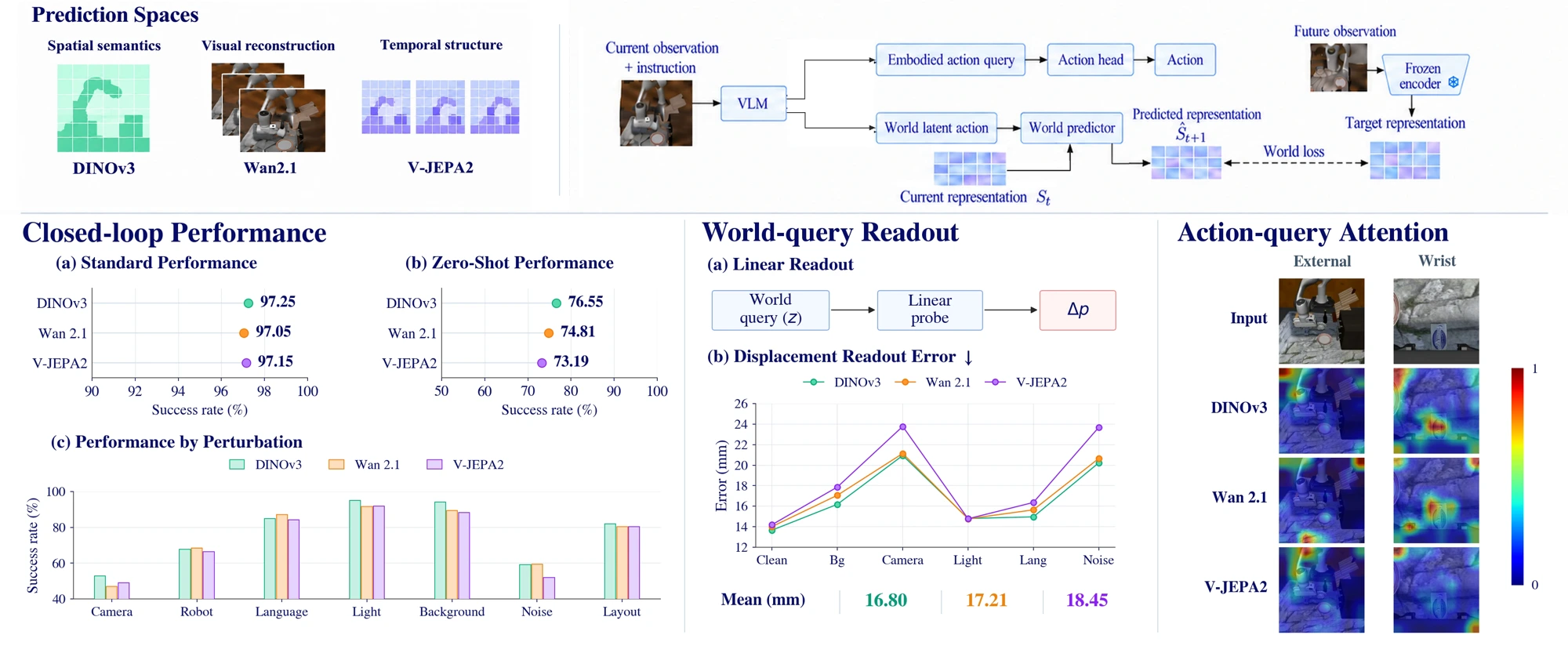
We study how future prediction targets shape policy generalization by comparing DINOv3 spatial semantic features, Wan 2.1 VAE reconstruction latents, and V-JEPA 2 predictive video features in a shared policy framework.
Comparison of prediction spaces through closed-loop manipulation, motion readout from world queries, and action-query attention.
Generalization under visual changes
The three policies differ by just 0.20 percentage points on LIBERO, but separate more clearly under LIBERO-Plus perturbations. DINOv3 provides the strongest overall generalization, with clear advantages over reconstruction supervision under camera, background, and lighting changes.
Motion readout and visual attention
World queries encode recoverable end-effector motion. DINOv3 supervision gives the lowest displacement-readout error under camera shifts, noise, and background changes, while action-query attention highlights manipulation-relevant regions.
PREWAM
PreWAM: Unifying Action Generation and Latent World Prediction
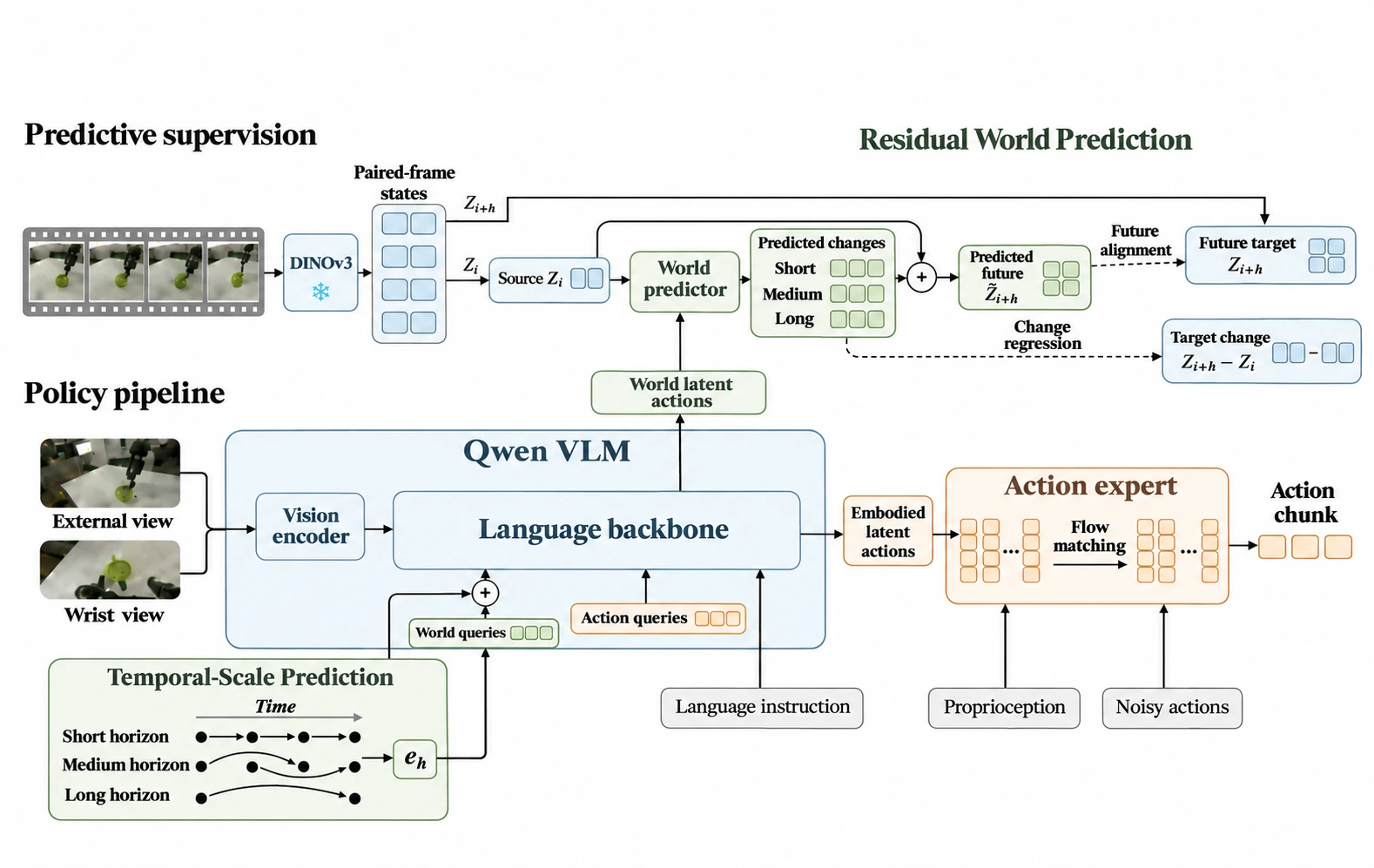
PreWAM integrates action generation and latent world prediction through a shared vision-language backbone. Given current observations and a language instruction, the backbone produces action queries for the action expert and world queries for the world predictor. Joint action and predictive supervision shapes representations that support both robot control and anticipation of visual state transitions.
Building on our prediction-space study, PreWAM predicts future states in a frozen DINOv3 feature space. Residual World Prediction models changes relative to a source state, while Temporal-Scale Prediction organizes supervision across short, medium, and long horizons.
Residual World Prediction
Starting from a source visual state, the predictor estimates a feature change. Adding this residual reconstructs a future state.
Temporal-Scale Prediction
Horizon-conditioned world queries learn short-, medium-, and long-range transitions within a sampled clip.
Training and Inference
Action learning and world prediction jointly train the shared backbone, with supervision determined by the data source.
Pretraining
Starting from a pretrained VLM, PreWAM jointly learns the backbone, world predictor, and action expert. Training alternates DROID robot demonstrations with Something-Something V2 human videos. Robot demonstrations provide both action and visual-transition supervision; human videos provide visual-transition supervision through the world-modeling objective.
Posttraining
The downstream policy inherits the backbone, world predictor, action expert, and learned queries from pretraining. It adapts to the target manipulation setting using demonstrations with joint action and world-modeling objectives. The target encoder remains frozen throughout pretraining and posttraining.
Inference
The VLM processes current observations and the language instruction. Conditioned on the resulting action-query representations and available proprioception, the action expert generates an action chunk through flow matching. World queries remain in the backbone input, preserving the training-time token context. The target encoder and world predictor are not executed.
BENCHMARK RESULTS
Manipulation performance and generalization
PreWAM combines strong manipulation performance with generalization under visual changes, static perturbations, and runtime interventions. We evaluate on the LIBERO benchmark family, SimplerEnv, RoboTwin 2.0, and a dual-arm Piper robot. Success rates are reported in %.
LIBERO and LIBERO-Plus
PreWAM achieves 98.1% on LIBERO and 79.1% on zero-shot LIBERO-Plus, leading the Robot, Language, and Light perturbation categories.
Method
LIBERO avg.
Camera
Robot
Language
Light
Background
Noise
Layout
Plus avg.
OpenVLA
76.5
0.8
3.5
23.0
8.1
34.8
15.2
28.5
16.3
OpenVLA-OFT
97.1
56.4
31.9
79.5
88.7
93.3
75.8
74.2
71.4
π₀
94.1
13.8
6.0
58.8
85.0
81.4
79.0
68.9
56.1
UniVLA
95.2
1.8
46.2
69.6
69.0
81.0
21.2
31.9
45.8
JEPA-WAM
96.7
79.2
59.2
68.2
93.3
94.6
83.6
76.1
79.2
Fast-WAM
97.6
16.4
44.5
68.9
78.2
53.7
37.7
60.7
51.5
Motus
97.7
17.9
43.3
74.1
54.7
44.9
26.2
52.0
44.7
ResVLA
96.6
49.8
59.9
88.5
90.5
94.9
76.8
79.0
77.1
LaWAM
98.6
37.2
71.6
87.1
93.5
94.1
69.4
83.3
76.6
PreWAM
98.1
54.6
73.0
89.3
97.4
93.9
62.7
83.1
79.1
LIBERO-Plus averages success across seven perturbation categories. Bold indicates the best result in each column.
LIBERO-Pro
Under changes to objects, positions, semantics, tasks, and environments, PreWAM reaches 58.7% average success, leading the Spatial and Object suites.
Method
Spatial
Object
Goal
Long
Avg.
OpenVLA
56.6
39.2
58.4
52.4
51.7†
π₀
50.4
42.6
45.2
37.6
44.0
π₀.₅
52.2
57.0
55.6
48.0
53.2†
VLA-JEPA
55.4
50.0
45.0
42.6
48.3
Fast-WAM
57.6
49.2
58.1
40.8
51.4
ImageWAM
63.0
47.6
42.2
42.0
48.7
LaWAM
63.2
54.6
46.0
47.0
52.7
JEPA-WAM
48.2
43.2
37.6
38.6
41.9
BridgeWAM
57.8
55.1
58.4
43.5
53.7
Faster-WAM
59.6
52.8
59.6
45.8
54.5
PreWAM
73.3
59.5
55.2
46.8
58.7
† Recomputed means.
LIBERO-Pro2.0
This benchmark distinguishes perturbations applied before execution from interventions during execution. PreWAM reaches 64.0% Static and 70.1% Runtime success.
Method
Base
Static success
Static Δ
Runtime success
Runtime Δ
OpenVLA
64.6
33.9
-30.7
36.4
-28.2
OpenVLA-OFT
97.1
58.9
-38.2
64.6
-32.5
π₀
63.8
38.6
-25.1
35.3
-28.4
π₀-FAST
80.4
53.2
-27.3
55.9
-24.5
π₀.₅
93.3
66.7
-26.6
73.8
-19.5
UniVLA
92.1
52.9
-39.2
61.0
-31.1
X-VLA
95.0
61.2
-33.8
66.0
-29.0
GR00T N1.7
90.4
60.0
-30.4
63.9
-26.6
Fast-WAM
97.8
55.9
-41.8
70.1
-27.6
PreWAM
92.1
64.0
-28.1
70.1
-22.0
Base evaluates eight unperturbed tasks. Static and Runtime apply perturbations before and during execution, respectively. Δ = success − Base, in percentage points.
SimplerEnv
PreWAM achieves the highest average success rates among the compared methods on both Google Robot (78.9%) and WidowX (69.8%) in SimplerEnv Visual Matching. It leads on Drawer and Place, and reaches 100.0% on Eggplant.
Google Robot
Method
Pick
Move
Drawer
Place
Avg.
GR00T N1
0.7
1.9
2.9
0.0
1.4
VLA-JEPA
88.3
64.1
59.3
49.1
65.2
RoboVLMs
77.3
61.7
43.5
24.1
51.7
villa-X
81.7
55.4
38.4
4.2
44.9
CogACT
91.3
85.0
71.8
50.9
74.8
StarVLA-OFT
95.3
75.0
68.8
66.1
76.3†
VideoVLA
92.3
82.9
66.2
50.9
73.1
PreWAM
91.3
73.3
75.0
75.9
78.9
WidowX Robot
Method
Spoon
Carrot
Block
Eggplant
Avg.
GR00T N1
1.4
0.0
0.0
13.9
3.8
VLA-JEPA
75.0
70.8
12.5
70.8
57.3
RoboVLMs
45.8
20.8
4.2
79.2
37.5
villa-X
48.3
24.2
19.2
71.7
40.8
CogACT
71.7
50.8
15.0
67.5
51.3
StarVLA-OFT
90.3
38.5
29.7
100.0
64.6
VideoVLA
75.0
20.8
45.8
70.8
53.1
PreWAM
83.3
58.3
37.5
100.0
69.8
† Averages recomputed from reported task scores.
RoboTwin 2.0
A single PreWAM policy handles 50 bimanual tasks, achieving 92.72% on Clean and 91.98% on Randomized settings. Its average success is 92.35%, with a 0.74-point gap between settings.
Method
Clean
Randomized
Avg.
π₀
65.92
58.40
62.16
π₀.₅
82.74
76.76
79.75
X-VLA
72.80
72.84
72.82
LingBot-VLA
88.56
86.68
87.62
Motus
88.66
87.02
87.84
GigaWorld-Policy
86.36
85.04
85.70
LaWAM
92.64
89.80
91.22
LingBot-VA
92.93
91.55
92.24
PreWAM
92.72
91.98
92.35
100 episodes per task in each setting. Avg. is the mean of Clean and Randomized success.
Real-world evaluation
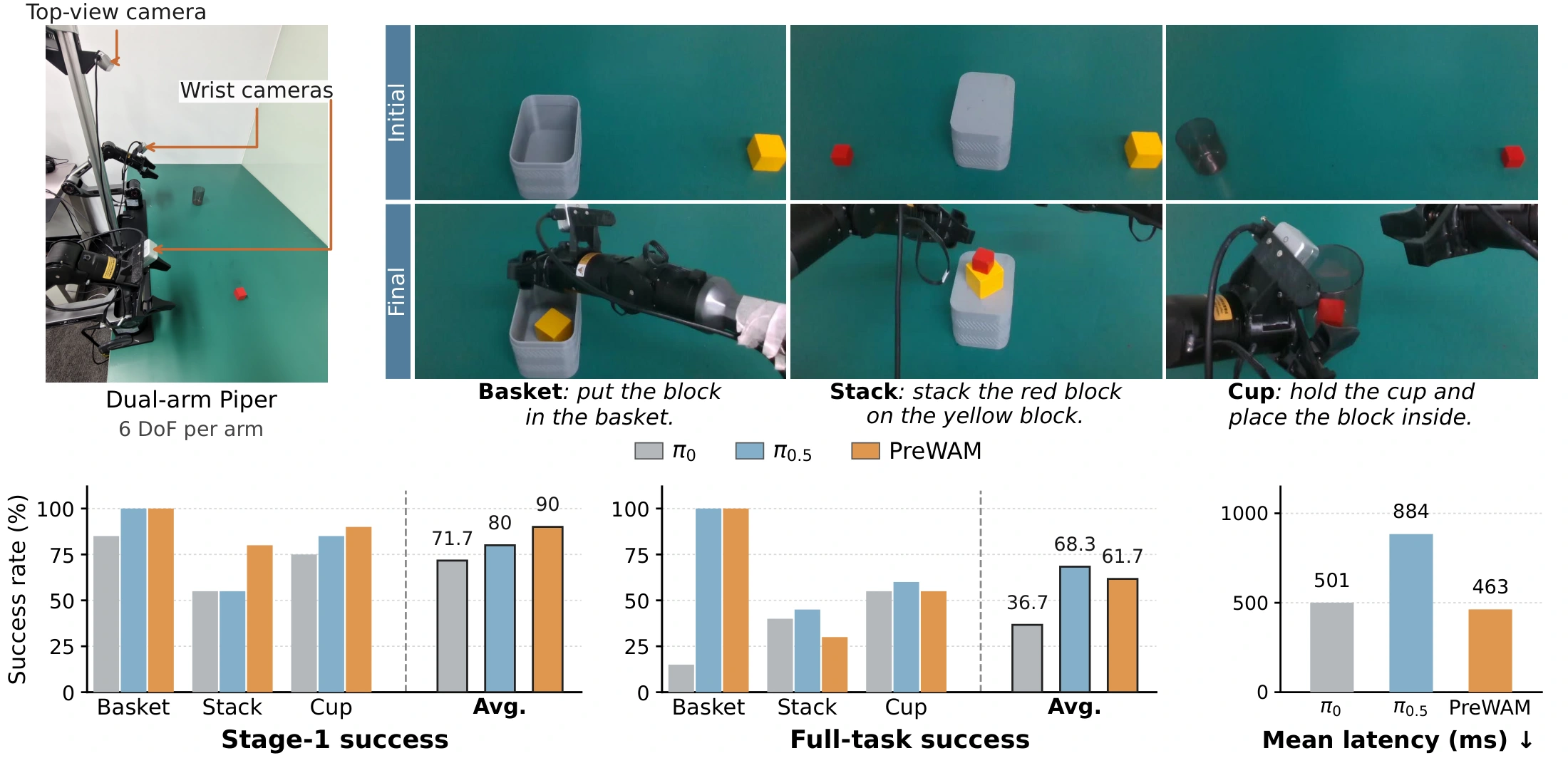
We evaluate on Basket, Stack, and Cup using a dual-arm Piper robot. Each policy receives 4,000 task-specific fine-tuning updates and is evaluated in 20 trials per task.
Mean stage-1 success is 90.0% for PreWAM. Mean full-task success is 61.7%, compared with 36.7% for π₀ and 68.3% for π₀.₅. Mean policy-call latency on an NVIDIA RTX 4090 is 463, 501, and 884 ms for PreWAM, π₀, and π₀.₅, respectively.
Simulation baseline results are from the corresponding papers and official benchmark reports; references and evaluation protocols are provided in the paper.
ABLATIONS AND ANALYSIS
Effects of predictive supervision and pretraining
RWP improves LIBERO-Plus success from 76.6% to 77.7%. Adding TSP further raises it to 79.1% and improves LIBERO-Long from 95.0% to 97.0%. World modeling and pretraining also contribute to long-horizon performance and generalization.
Configuration
LIBERO
LIBERO-Long
LIBERO-Plus
PreWAM
98.1
97.0
79.1
w/o TSP
97.6
95.0
77.7
w/o RWP & TSP
97.3
95.0
76.6
w/o WM
96.7
92.6
72.7
w/o pretraining
95.6
89.8
65.9
w/o TSP: single-horizon residual prediction. w/o RWP & TSP: direct future-state prediction. w/o WM: action supervision only in both stages. w/o pretraining: downstream training only.
Action stability under visual perturbations
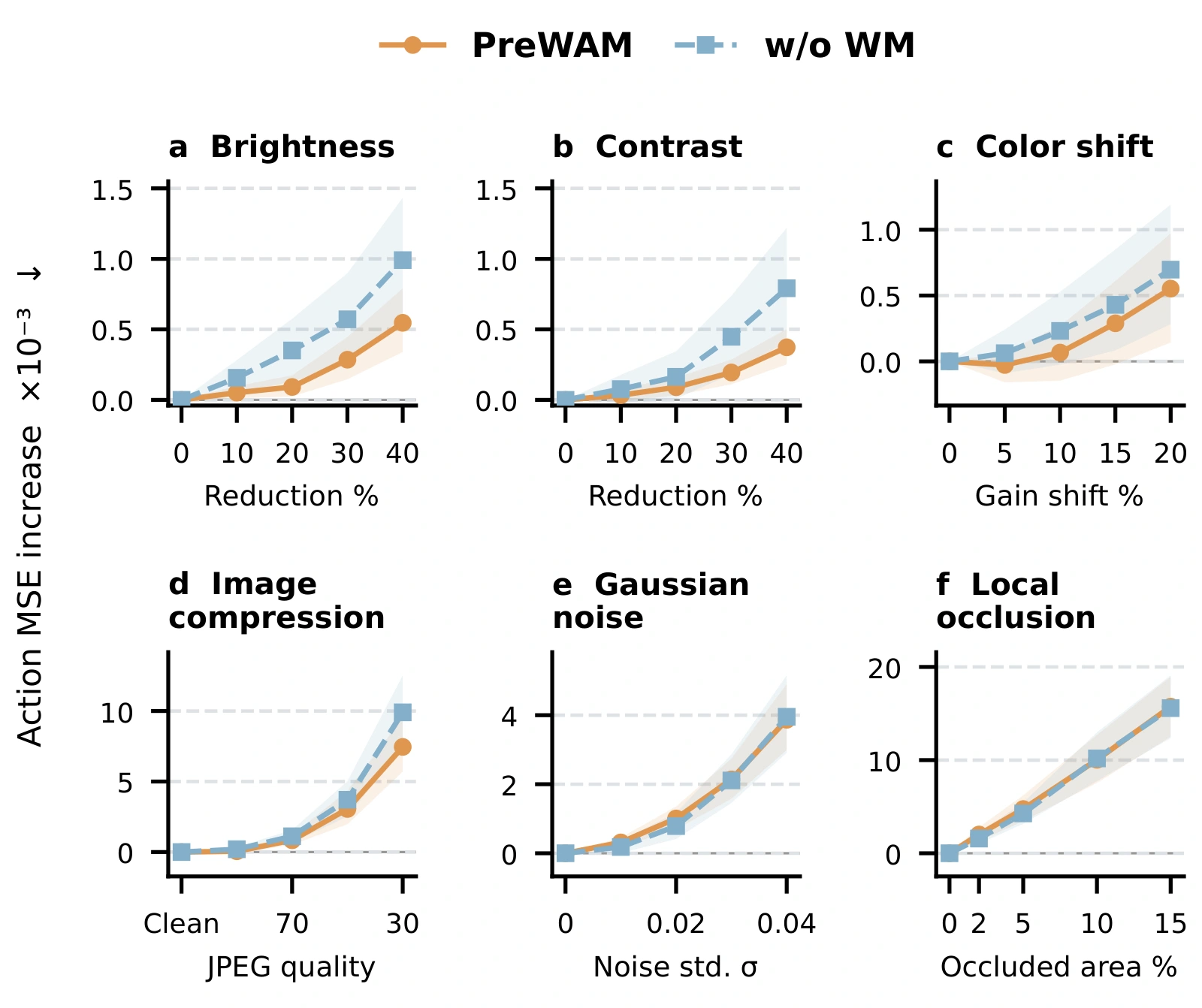
PreWAM produces more stable actions under brightness, contrast, color-shift, and image-compression perturbations. At 40% brightness and contrast reduction, action-MSE increases are 44.8% and 52.9% lower than without world modeling.
Action-MSE increase relative to clean inputs on 200 windows from LIBERO training demonstrations. Shading shows task-stratified 95% bootstrap confidence intervals; vertical scales vary.
Citation
@misc{chi2026prewam,
  title  = {PreWAM: Exploring the Design of Latent Future Prediction
            for World-Action Modeling},
  author = {Wan Chi and Sen Li and Zihang Cui and Chuqin Huang
            and Yunlong Wang and Nanshan Deng and Yanjun Huang},
  year   = {2026}
}